
INTERIM HOME CARE UTAH
Assisted Living vs. Memory Care: A Practical Guide
Most families researching this are trying to answer one of two questions: "which of these does my parent actually need," or "does either of these apply to us yet." We'll answer both, and we'll also tell you about the option a lot of families don't realize is still fully on the table.
The Actual Difference
Assisted living is built for seniors who need help with daily tasks — bathing, dressing, meals, medication — but are still largely independent and oriented. Memory care is a more specialized, usually secured environment built specifically for people with Alzheimer's or another dementia: locked or monitored exits to prevent wandering, staff trained specifically in dementia behaviors, and a lower staff-to-resident ratio.
In a lot of communities, these aren't even separate buildings — many facilities offer both, with a resident moving from the assisted living side to the secured memory care side within the same building as needs change.
Memory care typically costs somewhat more than standard assisted living, generally in the range of 15 to 30 percent more, though exact figures vary enough by facility and region that we won't pretend to hand you a precise number — that's a conversation to have directly with any community you're considering.
What Actually Decides Between Them
Cognitive status is the real dividing line, not just age or general frailty. A parent who's physically slowing down but still oriented, safe, and capable of recognizing danger is typically an assisted living fit. A parent with dementia who's at real risk of wandering, getting lost, or not recognizing unsafe situations is what memory care is built for.
The Third Option: Staying Home
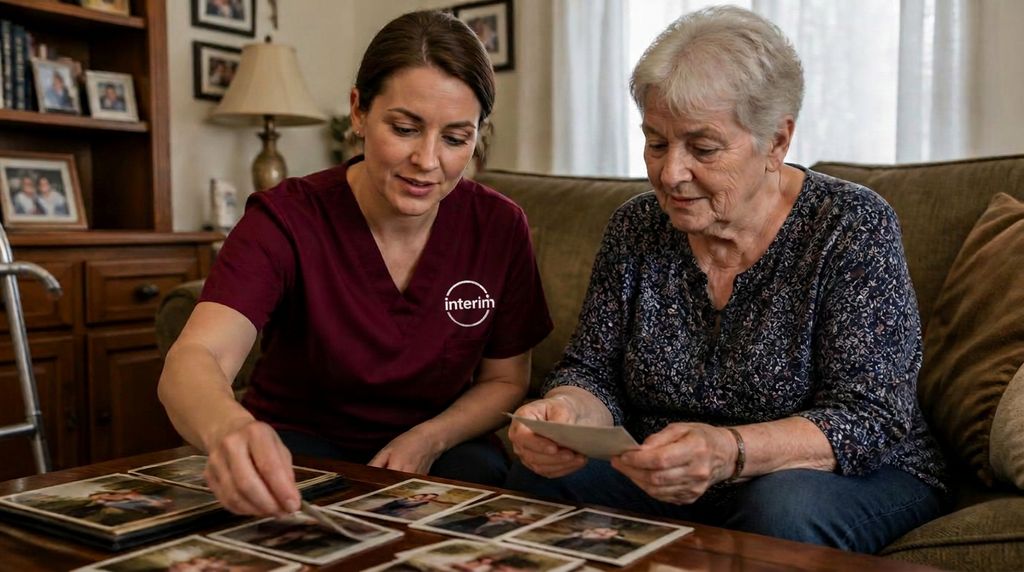
Here's what a lot of families don't realize: needing memory-care-level support doesn't automatically mean a facility is the only path. In-home dementia care with a trained Care Professional can provide the same kind of structured routine, redirection, and safety-focused support that memory care offers — in the home your loved one already knows, which for many people with dementia is itself calming in a way a new environment isn't.
We don't think this decision should come down to cost, and we're not going to pretend staying home is always the answer, either. What we do think matters is safety. If there's a real risk of physical harm — to your loved one or to a family member — that's when a secured facility environment offers something home genuinely can't replicate. Short of that, staying home is a legitimate, well-supported option for a lot longer than most families assume, if that's what your family wants.
What In-Home Dementia Care Looks Like With Interim
We're a non-medical home care agency, so we're not a substitute for a medical or hospice team if one's involved — we coordinate alongside them. What we provide is the daily structure and safety-focused support that makes staying home realistic: routine, redirection, supervision, and the kind of steady, familiar presence that a new facility environment can't offer on day one.
Our 7th Week Guarantee
No long contracts. If you don't feel the difference after six weeks of care at 20 or more hours a week, your seventh week is free.
Get Started
Call us at (801) 401-3515 and tell us what you're weighing. We'll give you an honest read on whether staying home is realistic for your specific situation — not a sales pitch either way.
Learn more about our dementia care services, what in-home dementia care actually costs, or VA benefits that can help pay for it.
Dementia, Alzheimer's & Memory Care
More from this series
Memory Aids for Dementia: What Actually Helps | Interim
Simple, low-tech memory aids often work better than complicated apps or devices for someone with dementia. Here's what to actually try.
When a Dementia Patient Refuses to Go Into Care | Interim
When a loved one with dementia refuses help — a facility, a caregiver, even basic assistance — here's why it happens and what tends to work better than pushing harder.
Does Medicare Cover Memory Care? | Interim Home Care
Medicare doesn't cover memory care room and board, but it does cover certain medical services within that setting. Here's exactly what's covered and what isn't.
Memory Care, Explained | Interim Home Care Utah
What memory care actually is, who it's for, what it costs, and the genuine alternative of staying home. The complete starting-point guide.