
INTERIM HOME CARE UTAH
Eating Challenges in Dementia: Why They Happen and What Helps
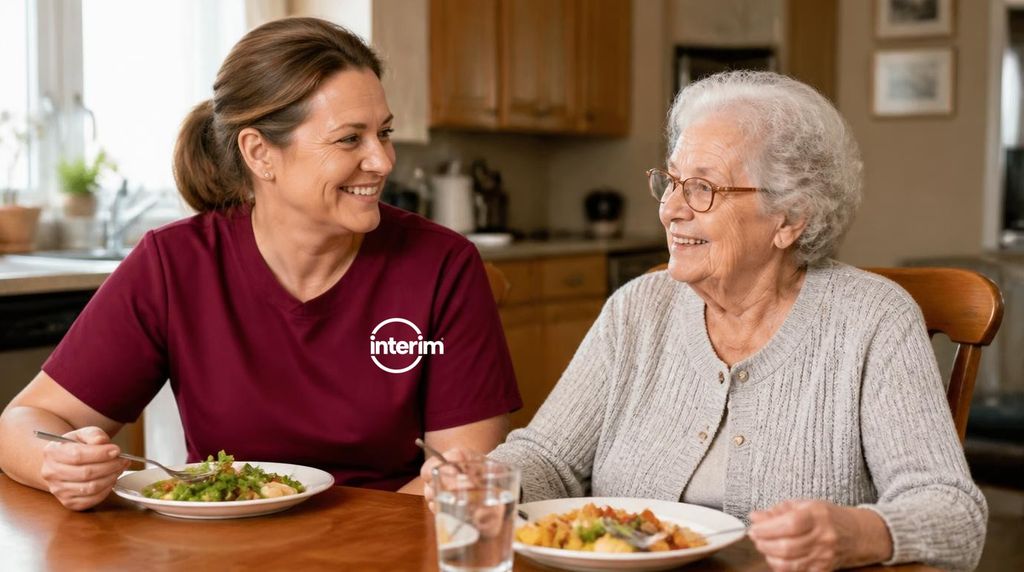
If your loved one is eating less, refusing meals, or seems to have forgotten how to eat altogether, it's genuinely one of the more distressing parts of dementia care — and it's important to know upfront: this isn't a choice they're making.
Why This Happens
Several things can be going on at once: forgetting that they've already eaten or forgetting to eat at all, losing the ability to recognize food as food due to changes in visual processing, difficulty coordinating the physical movements needed to eat, reduced sense of smell and taste making food less appealing, medication side effects that suppress appetite, and depression, which is common alongside dementia and can independently reduce interest in eating. In later stages, actual physical difficulty swallowing (dysphagia) can develop, which is a different and more serious problem than simply forgetting to eat.
When It's Something Else Entirely
A sudden change in eating, rather than a gradual one, is worth flagging to a doctor rather than assuming it's just dementia progressing. Pain, a urinary tract infection, a dental problem, or ill-fitting dentures can all cause someone with dementia to stop eating — and because they may not be able to explain what hurts, a sudden refusal to eat is sometimes the only signal.
What Actually Helps at Mealtime
- Offer several small meals rather than three large ones, since a smaller plate can feel less overwhelming.
- Reduce distractions at the table — a quiet, simple setting helps someone stay focused on the meal itself.
- Serve favorite foods when appetite is low, rather than insisting on a perfectly balanced plate every time — some nutrition beats an uneaten "ideal" meal.
- Watch for chewing or swallowing trouble — coughing during meals, a wet or gurgly voice afterward, or holding food in the mouth without swallowing are signs worth mentioning to a doctor, since a speech-language pathologist can assess swallowing safety.
- Keep fluids visible and offered often — people with dementia often lose the ability to recognize thirst, so dehydration is a real risk even when someone isn't outright refusing drinks.
- Sit and eat with them when possible — mealtime as a shared, social moment often encourages more eating than a plate set down alone.
How Interim Can Help
Mealtime support — encouragement, supervision for safety, and simply making sure meals actually happen consistently — is one of the most common day-to-day tasks our Care Professionals help with. We're a non-medical home care agency, so if a swallowing or medical issue is suspected, we'll flag it for a physician rather than try to manage it ourselves, but the daily reality of getting food and fluids in is exactly the kind of support we provide.
Our 7th Week Guarantee
No long contracts. If you don't feel the difference after six weeks of care at 20 or more hours a week, your seventh week is free.
Get Started
Call us at (801) 401-3515 if mealtime has become a struggle. We'll talk through what support could look like.
Learn more about our dementia care services, or read about the timeline of dementia stages to understand what's typical at each point.
Dementia, Alzheimer's & Memory Care
More from this series
Memory Aids for Dementia: What Actually Helps | Interim
Simple, low-tech memory aids often work better than complicated apps or devices for someone with dementia. Here's what to actually try.
When a Dementia Patient Refuses to Go Into Care | Interim
When a loved one with dementia refuses help — a facility, a caregiver, even basic assistance — here's why it happens and what tends to work better than pushing harder.
Does Medicare Cover Memory Care? | Interim Home Care
Medicare doesn't cover memory care room and board, but it does cover certain medical services within that setting. Here's exactly what's covered and what isn't.
Memory Care, Explained | Interim Home Care Utah
What memory care actually is, who it's for, what it costs, and the genuine alternative of staying home. The complete starting-point guide.